
Three New Manager Capabilities for 2026 That May Surprise You
The shifts in manager expectations aren’t always stated directly. But they are increasingly in the air.
Reading between the lines of cutting-edge research, from the World Economic Forum to global workforce studies, leadership trend reports, and analyses of AI-driven work, a clear pattern is emerging. Senior leaders are beginning to expect a different set of capabilities from managers than the ones most organizations have historically trained for.
These expectations aren’t about doing more with less effort. They’re about operating effectively in environments defined by fewer buffers, flatter structures, AI-accelerated workflows, and heightened uncertainty. If organizations want to ensure manager readiness for 2026–2030, they need to understand what is changing, embed new language and expectations into the culture, and provide learning opportunities that enable real behavior change, not just conceptual awareness.
The Evolution of the Manager
If we look back over past years, there have been clear shifts in what organizations expect from managers. We moved from boss to coach, as directive authority gave way to guidance and development. Then came a strong focus on emotional intelligence, followed by an emphasis on grit and resilience as work became more volatile. The post-pandemic manager marked another evolution altogether, with managers acting as stabilizers through burnout, uncertainty, and disruption, often without clear playbooks.
Each of these shifts reflected real changes in how work was experienced.
Now we are moving into the era of Context. This reveals itself through the realities of: increased scope with few layers of support, flatter organizational structures, AI-accelerated workflows that compress time and decision cycles, and hybrid and digital environments where cues are harder to read.
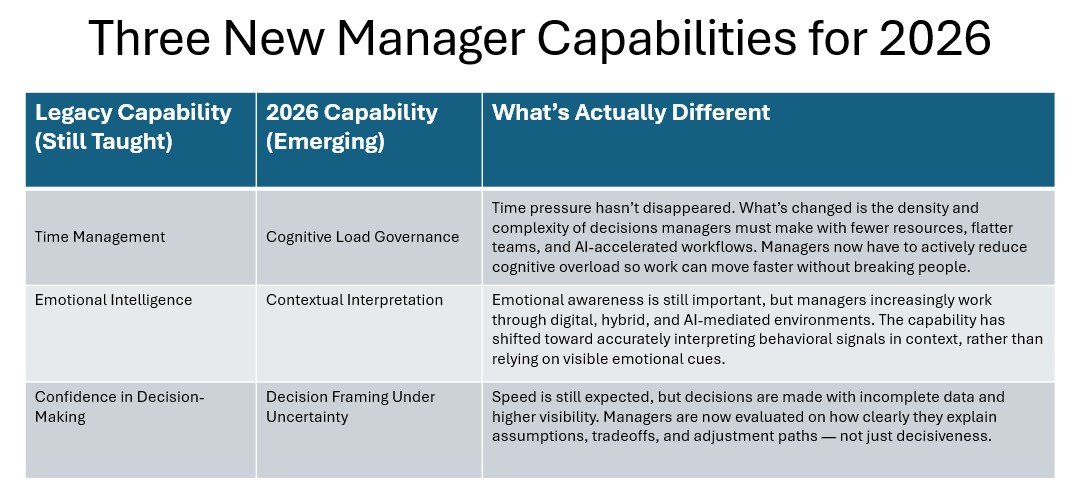
In this environment, familiar manager skills haven’t disappeared. Time management still matters. Emotional intelligence still matters. Confidence still matters. But they are no longer sufficient on their own. Managers are increasingly evaluated on their ability to interpret what is happening around them, understand the conditions people are operating within, and act accordingly.
Why Waiting Is the Wrong Strategy
Manager readiness shouldn’t lag two years behind the book that eventually names it. It needs to begin when the conditions emerge that make new capability gaps inevitable.
In reality, at least ten forces are already doing that work. To name a few, organizational flattening has increased manager scope and ratios. AI has accelerated work and multiplied decision density without increasing certainty. And newer-in-career employees are being promoted into management roles faster, often without preparation for the complexity of people leadership.
When those forces are in place, the gaps are no longer theoretical. They are structural.
What This Shift Is Producing
Taken together, these realities signal more than an expansion of the manager role. They represent a shift in kind. Senior leaders are beginning to expect managers to operate less as task supervisors or emotional anchors and more as interpreters of complex systems.
That expectation shows up in how work is prioritized, how people are supported, and how decisions are communicated. It also explains why a different set of capabilities is starting to surface as organizations look ahead in 2026.
Three New Manager Capabilities for 2026
A different set of manager capabilities begins to emerge — not as replacements for traditional skills, but as evolutions shaped by context.
Why This Matters Now
Research consistently suggests that core workplace skills will continue to shift through the end of the decade, particularly for roles that sit at the intersection of people, systems, and execution. Managers sit squarely at that intersection.
Without new language and support, many managers are left trying to meet evolving expectations with outdated tools. The result is strain, misalignment, and missed opportunity. Organizations that recognize these capability shifts early can better align expectations, culture, and learning design with the realities managers are already facing.
From Orientation to Action
This January edition is intentionally orienting rather than instructional. Its purpose is to surface what is changing and establish a shared framework for understanding the evolution of the manager role.
In the months ahead, each of these capabilities deserves deeper exploration and practice, and we'll dive into that.
The manager role is being recast, yet again.