
The Manager Capability Shift: Decision Framing Under Uncertainty in 2026
Confidence is baseline. Framing decisions under uncertainty is the next level.
It’s time to close the loop on the new manager capabilities for 2026.
Back in January, I introduced three capabilities I believed would become increasingly important as managers navigated flatter structures, wider spans, AI-accelerated workflows, and faster decision cycles. We went deeper on the first two in the months that followed. Now, before we turn toward our fall report—looking at how managers actually experienced 2026 and what those patterns may signal for 2027—I want to close the series with the third.
This one is critical.
I’ve intentionally made this installment more practical. The goal is to give managers a clear method for making better decisions even when they do not have all the information they would ideally want. Because increasingly, they won’t.
What Decision Framing Under Uncertainty Is
Decision Framing Under Uncertainty is a manager’s ability to make decisions with incomplete information while creating clarity about:
what the decision is, why it’s being made, what it assumes, what it trades off, and how it will adapt as conditions change.
This isn’t about sounding certain. It’s about making decisions usable.
Managers have always been expected to move work forward through judgment, clarity, and decisiveness. Today, those expectations are largely baseline. The emerging requirement is the ability to make a sound decision while also helping other people understand its logic, limits, and implications. That is the shift we identified in January from traditional confidence in decision-making toward Decision Framing Under Uncertainty.
Why This Is Harder Now
Many organizations are operating with fewer buffers: flatter structures, higher manager ratios, faster cycles, and more cross-functional dependencies. AI adds another layer by producing options, analysis, drafts, and recommendations at speed.
Managers are therefore making decisions faster, with more inputs, less certainty, and often greater visibility across the organization.
Under those conditions, the old question—“Did I make the right decision?”—is no longer enough. A better question is:
Have I made the best decision available with what we know now—and framed it so others understand the assumptions, tradeoffs, action required, and conditions under which we would change course?
That requires two manager moves.
Move 1: Choose Speed With Substance
Most managers have a default decision style.
Some lean toward precision and refinement. Under uncertainty, that can become analysis paralysis: continuing to gather information, waiting for perfect, and trying to reduce uncertainty to zero before moving.
Others naturally favor speed and forward motion. Their failure mode is different: speed without control. The decision gets made, but likely exceptions, dependencies, or interpretation risks have not been considered. People begin inventing their own exceptions, escalating unpredictably, and applying the decision differently across teams. Eventually, the decision comes back.
Speed with substance solves for both.
It drops the demand for perfect while still reaching for exceptional.
Substance does not mean a long explanation. It means the decision has enough structure to prevent unnecessary confusion and rework.
A manager practicing speed with substance makes the decision without waiting for perfect information, anticipates where it is most likely to break, and establishes what evidence would justify revisiting it.
Speed with substance is how we protect exceptionalism without creating a boomerang.
Move 2: Frame the Decision So Others Can Use It
In complex organizations, the decision itself is only half the job.
When shared understanding is missing, teams don’t execute the decision.
They execute their interpretation of it.
And uncertainty multiplies. Shared understanding does not mean consensus. It means people are sufficiently clear on what was decided, why, what changes now, what constraints matter, and when the decision might be reconsidered. People can disagree and still be aligned if they understand what coordinated action requires.
The managerial discipline, then, is not simply “I decided.” It is: “I decided—and I have made the decision executable.”
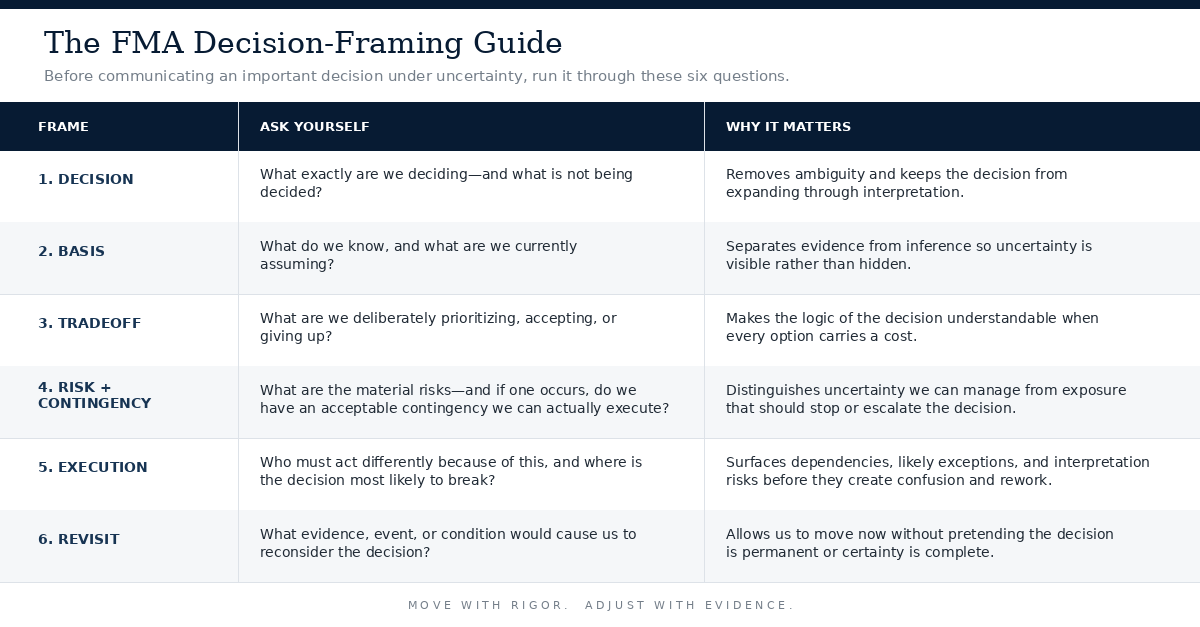
Move with rigor. Adjust with evidence. Escalate when the risk cannot be responsibly contained.
You do not need to eliminate uncertainty before acting. You need to make uncertainty visible, understand the material risks, and determine whether you have a contingency you can responsibly execute if those risks occur.
That is the stop test.
If the risk is understood and the contingency is acceptable, move. If a material risk cannot be adequately contained—and the consequences sit beyond your authority or tolerance—stop and communicate it upchain. Uncertainty itself should not paralyze a decision. Uncontained risk should.
Then Check for Shared Understanding
Once the decision has been framed, communicate it simply:
Decision. Rationale. Constraint. Next step.
Then check the interpretation—not whether everyone agrees.
Ask what people heard the decision to be and what it means for their area. Surface the first dependency or risk that could prevent it from holding. Clarify what people need in order to align execution. That conversation can take minutes. The cost of skipping it can last weeks.
What This Means for Managers
Decision Framing Under Uncertainty is not decisiveness with a new name.
Decisiveness remains foundational. This capability adds the structural discipline required when certainty is unavailable: separating evidence from assumptions, recognizing tradeoffs, assessing material risk, establishing executable contingencies, anticipating where execution could fracture, and setting explicit conditions for changing course.
It also reflects the broader evolution of the manager role we began discussing in January.
Managers are increasingly operating at the intersection of people, systems, and execution. They are not simply supervising work or providing emotional stability. They are interpreting complex conditions and helping other people act within them.
That makes the quality of the frame increasingly as important as the decision itself.
And perhaps that is one of the clearest manager shifts of 2026:
Strong managers do not manufacture certainty. They create enough clarity to move responsibly without it.